IS THERE A SECOND SPHINX AT GIZA?
Yes, but not where it is claimed to be
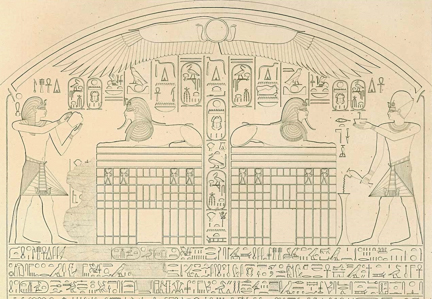
Dream Stela and the two back-to-back sphinxes.
Dream Stela and the two back-to-back sphinxes.
Recent developments using SAR technology on a sand-covered mound at Giza by engineer Fillipo Biondi reveal a potential second sphynx west-north-west of the present monument and directly west of the pyramid attributed to Khafre. The spot’s location, although odd, does have an axially symmetrical arrangement to that of the known Sphynx and the pyramid attributed to Khufu. Given how the limestone bedrock is pockmarked with hundreds of caverns, tunnels and shafts, most natural, some man-made, Fillipo is sensibly making further investigations.
Fillipo brought up the Dream Stela as an inspiration for the potential existence of a second sphynx. This is the stela placed between the paws of the Sphinx by Thutmosis IV. Indeed it depicts back-to-back sphinxes, each reclining on a structure resembling a building or a series of structured vaults; the text describes a dream had by Thutmosis as he slept in the shade of the monument. No reference is made to two creatures.
To place things in context, by this pharaoh’s time, memories of the remote past were thin. Ancient traditions were being misinterpreted, legends were accidentally muddled or confused, even gods were reassigned to new duties as changes evolved in the political landscape. It would be odd if the Dream Stela should be the exception, so let’s examine several possibilities.
It was typical for gods, pharaohs and other entities to be awarded a birth name, and a second, sacred or royal title. With regard to the Sphinx the earliest known name was Sheshep Ankh (Eternal Image), while its sacred title was Hor-em-Akhet (Horus of the Horizon). Thus it would appear that the back-to-back sphinxes on the Dream Stela reflect the entity’s dual title.
A second possibility is the aforementioned connection with the horizon. In the 1990s Robert Bauval and Graham Hancock published a theory that Sheshep Ankh was originally carved into the shape of a crouching lion who gazed at its celestial counterpart on the eastern horizon, the Leo constellation, on the spring equinox c.10.500 BC. It is a well-reasoned and convincing theory, but with regard to the two-sphinx idea it may only reflect half the story.
In ancient Egypt the god Aker personifies the eastern and western horizons, for it is his duty to guard the journey of the Sun from sunrise to sunset, or as it was later described, the passage from yesterday to tomorrow. This ability to look forward and behind led to Aker’s depiction as two lions sitting back-to-back.
Around 2400 BC Aker’s association with the double horizon became synonymous with the eternal cycle of life, death and rebirth and the passage of the soul into the Otherworld. Funerary texts such as the Book of Coming Forth By Light mention the House of the Twin Lions as a symbolic structure into which the soul enters during its ascent into the Otherworld. In this context the two lions protect the sacred domain, with Aker the double lion guarding “the gate to the site beyond.”
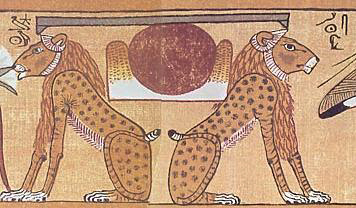
Aker depicted as two lions.
This may explain the back-to-back sphinxes on the Dream Stela but hardly validates the notion that a second Sphinx once guarded the entrance to the Giza plateau. A stronger case can be made for another entity, the goddess Mehit who is depicted as a crouching lioness.
In her capacity as a feline she is associated with the guardianship of sacred places — much like Aker — as well as with the Moon and the restoration of divine order in the cosmos. Mehit is married to the hunter god An-hur, who in time is reassigned as a war god — a position wholly incompatible with Mehit’s functions as lunar goddess and protector of sacred places.
But further along the dirt road of history things get confusing, when there appears a second, near-identical lion goddess named Menhet: both goddesses originate from Nubia, both restore cosmic order after replenishing the Eye of Horus, both reinforce the cycle of periodic renewal. The only way to distinguish the two is by their crowns: the former wears the crown of Osiris and horns of Khnum, while the latter bears the sun disc and uraeus. And by the fact that Menhet herself is a solar goddess whose title means ‘she who sacrifices or slaughters’; like her near namesake she is incompatibly married, to the ram-headed Khnum, one of the oldest creator gods, whose responsibilities lie in breathing the life force into humans and regulating the annual flooding of the Nile.
As I mentioned earlier, the exceptionally long traditions of Egypt meant that deities were often reassigned new roles, and it is very likely that at some point Mehit the goddess was split into two similar albeit separate deities.
We must also consider the idea of two almost interchangeable goddesses whose qualities are at cross-purposes with the gods they married: in a perfect universe the aggressive Menhet and An-hur would be better suited, while Mehit and Khnum reflect each other as regenerative, life-affirming gods, least of all because Mehit is depicted wearing the horns of Khnum, and the word mehit bears the meaning ‘flood’ (see E.A. Wallis Budge).
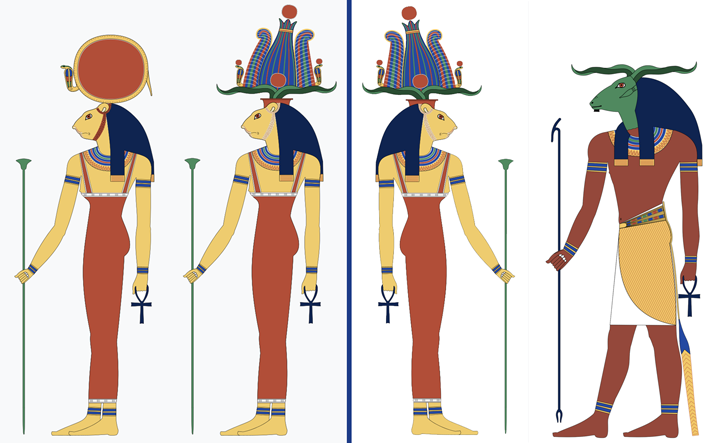
Menhit and Mehit. And Mehit and Khnum.
It is this observation that leads me to the potential existence of two physical sphinxes at Giza: one depicting Mehit the lioness, the other her proper spouse, the ram-headed Khnum.
If Mehit was a protector of sacred places, and specifically buildings housing the knowledge of the gods, surely there would have been two guardians. This is where I recalled an Arabic account published in the 11th century describing a second sphinx — not as one would imagine in Giza, but across the Nile, opposite the monument we know so well.
Greek, Roman and Muslim commentators mention a second Sphinx. All claim that they faced each other. In the Annals of Rabi II of 1024, Mohammad ibn al-Musabbihi mentions a smaller sphinx "south of Cairo" in a "ruined state of brick and stone” across the Nile from the present monument, its mud brick core eroded by the Nile "lapping at its feet" and its limestone casing stones removed by labourers for building work in Cairo. In the early 12th century the celebrated cartographer Muhammad al-Idrisi makes the same assertion in his works Al-Kitab al-Jujari, and Kitāb al-Masālik wa-l-Mamālik; whether from direct observation or in reference to al-Musabbihi is not clear.
Clearly there once existed two sphinxes facing each other across the Nile and must have made quite the impression on any individual sailing down the river, creating as they did a gateway into the sacred precinct of Iwnw (today the Cairo suburb of Heliopolis), as well as its counterpart on the west bank, the temple and pyramid complex at Giza and the subterranean domain of Rostau.
Just as a celestial archive exists in the sky, so did it exist in physical form at the academy of the gods at Iwnw. Meanwhile its potential underground counterpart at Giza, guarded by a protective lioness, was given new emphasis in the 1990s when Thomas Dobecki and Robert Schoch located a chamber in the vicinity of the left paw of the Sphinx using seismic technology.
Depictions of Mehrit as a crouching lioness show her wearing neck-rings; on the actual Sphinx, as Dr. Schoch points out, a neck-ring was present up until the early-twentieth century, either as a carved feature, now eroded, or a natural feature developed from weathering and erosion. Regardless, the neck-ring feature on the Sphinx and its depiction on Mehit the lioness further corroborates the association between the two entities.
The question is, did the two sphinxes depict Mehrit? Or did they depict the goddess and her consort Khnum, the flood god? To answer this we turn once more to the relationship between sacred monuments and the sky.
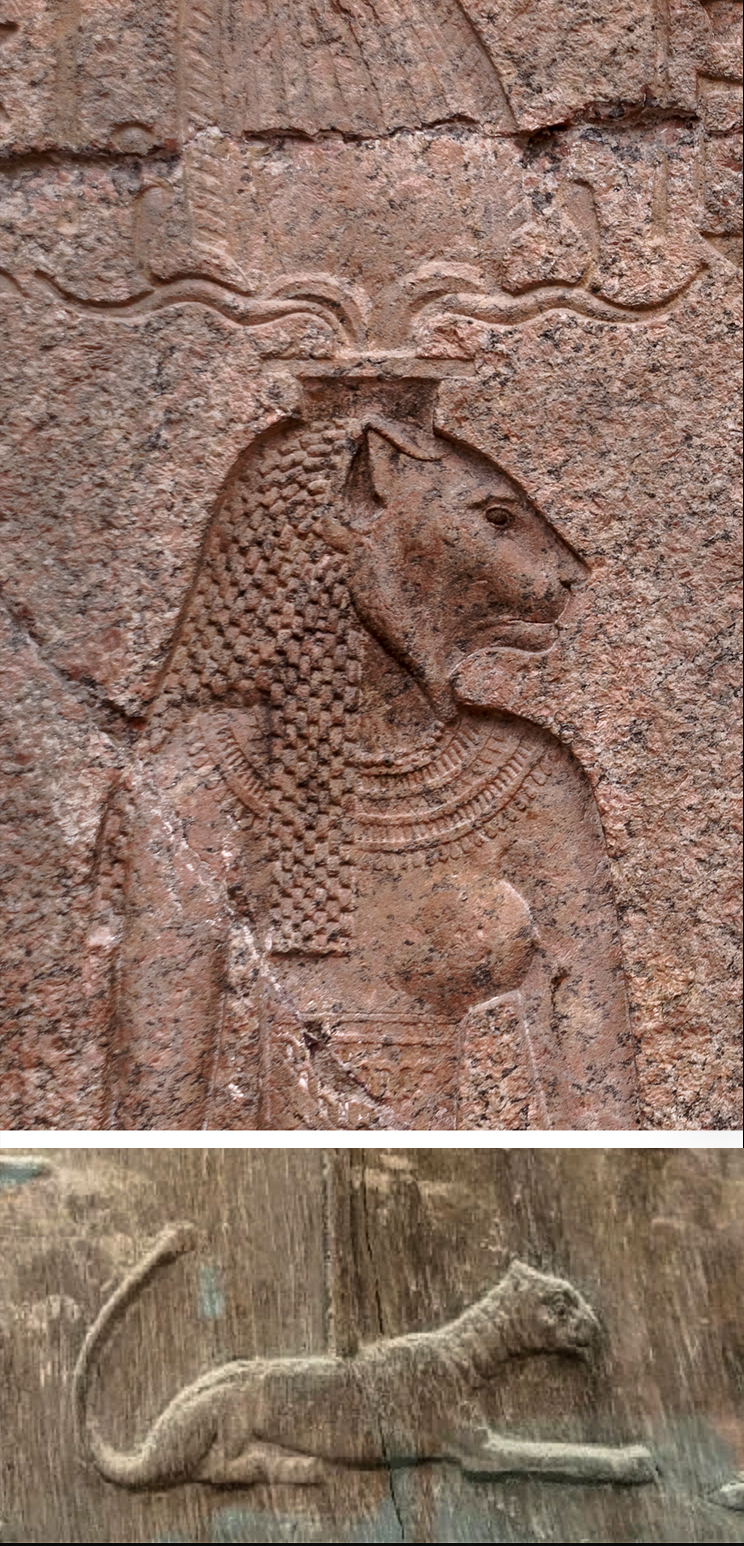
Mehit and her depiction as a reclining lioness.
In Egypt, practical functions were paired with a second, esoteric meaning. When the star Sirius rose heliacally in the constellation Leo it signaled the fullness of the Nile as it reached flood stage. The combined event was said to herald the opening of a gateway in the sky to the house of Mysteries — Sirius being equated with sacred teachings, which fell under the protection of divine kingship in the form of Leo. The event would later take on the title, The Opening of the Lion’s Gate. In the era of 10,500 BC — Zep Tepi, the First Occasion — the Shining Ones, Followers of Horus arrive from their partially destroyed island in the Indian Ocean to build a new world of the gods, starting with the founding of sacred mounds along the Nile upon which the future historic temples would rest.
One of these mounds, Iwnw, became the main academy of the gods. With the Nile as the terrestrial Milky Way, a snapshot of the spring equinox sky of the region sees Sirius rise above Iwnw, while further along, Leo rises from the eastern horizon to face its terrestrial counterpart, the Sphinx lioness Mehrit. At the same moment, sitting on the east bank of the Nile and looking westward, the second Sphinx in the form of the ram-headed Khnum gazes at its counterpart, the constellation Aries, as it descends into the western horizon.
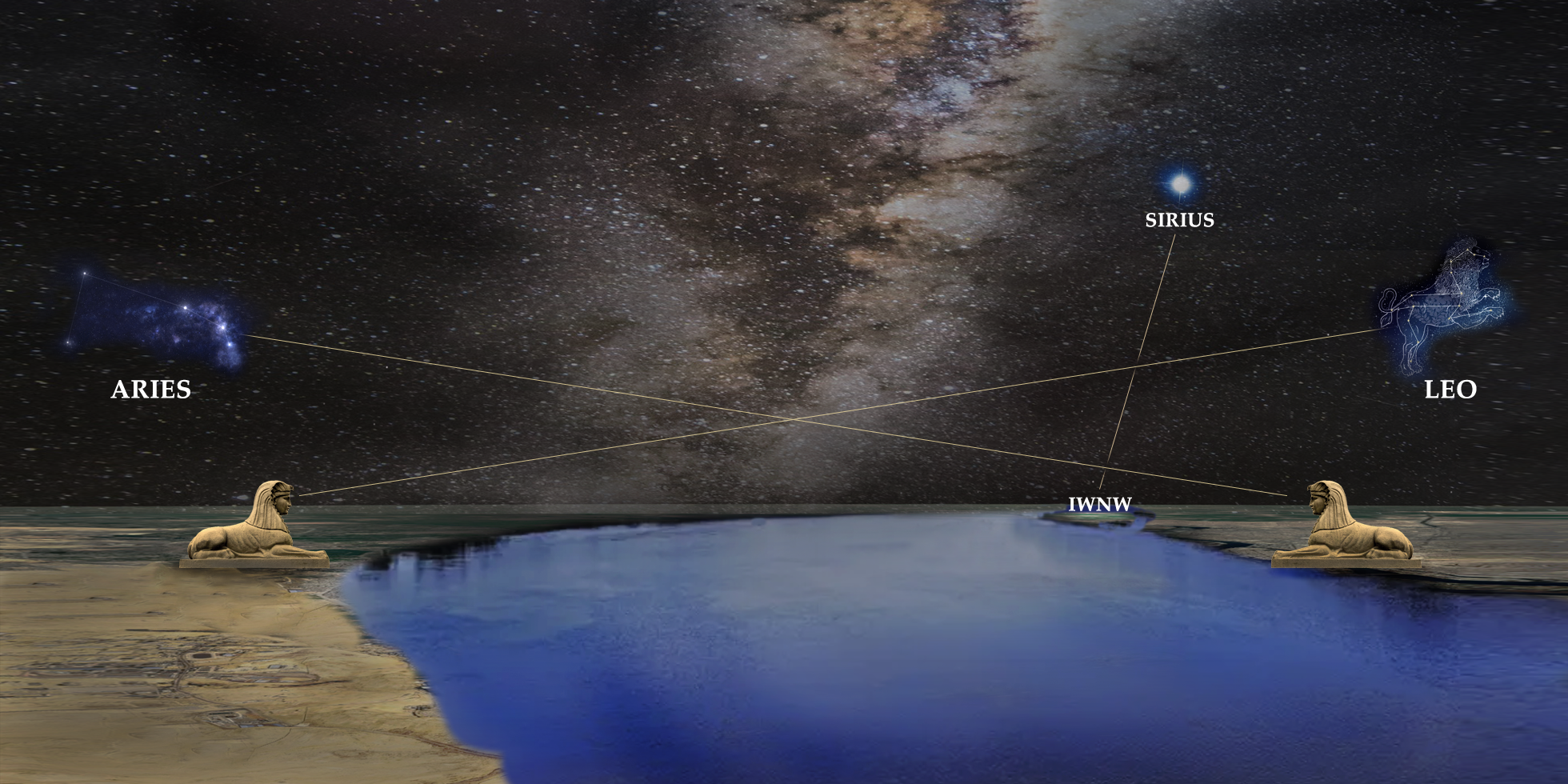
The two sphinxes on the Nile and the sky on the spring equinox 10,500 BC.
Two guardians.
Two horizons.
Two Sphinx.
One a crouching lioness, the other a reclining ram.
©Freddy Silva. No unauthorized reproduction.
For additional viewpoints/references see:
Seyfzadeh, Schoch and Bauval. A New Interpretation of a Rare Old Kingdom Dual Title: The King’s Chief Librarian and Guardian of the Royal Archives of Mehit, Archaeological Discovery, vol. 5, 2017, pp. 163-177
Robert Schoch and Robert Bauval, Origins of the Sphinx, Inner Traditions, 2017
Return to Manuscripts